
- All
- Product Name
- Product Keyword
- Product Model
- Product Summary
- Product Description
- Multi Field Search
- Product private attributes
Views: 0 Author: Site Editor Publish Time: 2026-10-07 Origin: Site


Holiday lighting contractors face a hidden profitability killer every single season. Mid-season callbacks caused by premature bulb failure drain your resources and ruin tight schedules. You constantly balance minimizing upfront material costs with maximizing installation reliability. Cheap materials inevitably erode your hard-earned margins. They lead to unbillable maintenance hours and severely damaged client trust. Dispatching repair crews for repetitive troubleshooting is a time-consuming grind you must avoid.
This guide provides a technical framework for evaluating, selecting, and procuring commercial-grade lighting inventory. You will learn how to analyze diode architecture, evaluate weather resistance, and implement strategic supplier selection to streamline your procurement process. Upgrading your core inventory ensures your displays survive harsh winter conditions without constant human intervention.
Prioritize Diode Quality Over Unit Price: Surface-Mounted Device (SMD) LEDs offer superior brightness and longevity compared to legacy Dual In-line Package (DIP) bulbs, directly reducing mid-season failure rates.
Standardize Inventory SKUs: Limiting core inventory to specific sizes and color temperatures (e.g., standardizing on 5-diode C9s for rooflines) streamlines installation and simplifies mid-season troubleshooting.
Optimize Packaging for Labor Savings: Sourcing loose bulk cases rather than retail-packaged boxes eliminates the repetitive, time-consuming grind of unboxing thousands of bulbs on the job site.
Verify Batch Consistency: Sourcing from suppliers with strict binning processes prevents the "mismatched warm white" problem across different installation zones.
Account for Long-Term ROI: Factor in warranty terms, shipping logistics, and defect rates when calculating the true ROI of wholesale purchases.
Every time a bulb goes dark on a second-story roofline in December, your profit margin shrinks. Dispatching a two-person crew to replace a single failed diode involves drive time, ladder setup, and strict safety protocols. This unbillable labor steals time from new, profitable installations during your busiest weeks. A commercial light's true value lies in its survival rate on the job site. We measure success by a bulb's ability to endure a 60-to-90-day deployment in freezing rain, high winds, and snow without any intervention.
Strategic volume purchasing protects your margins from seasonal volatility. Forecasting your material needs in August or September shields you from late-November stockouts and supply chain bottlenecks. Peak-season desperation often forces contractors into buying inferior retail products just to finish a job. Securing your inventory early ensures you always have the right materials on hand. You must weigh the financial trade-off of holding extra safety stock against the exorbitant fees of expedited emergency shipping. Having a buffer of reliable inventory is always more profitable than halting a job while waiting for a delivery truck.
Streamlining your procurement process requires analyzing historical installation data. Review your previous season's footage totals and replacement rates. Use this data to build accurate, comprehensive purchase orders. Disorganized, last-minute sourcing leads to mismatched colors and incompatible bases. A data-driven approach eliminates the pain of scrambling for inventory when the frost hits. Proper planning keeps your crews moving efficiently from one property to the next.
To accurately calculate the true cost of a callback and justify commercial-grade purchases, follow these tracking steps:
Log the total drive time for the repair crew from the shop to the client's property and back.
Record the on-site labor time required to set up ladders, diagnose the dead string, and replace the faulty components.
Calculate the lost revenue from the new installation jobs that were delayed due to the emergency repair dispatch.
Track the specific brand and batch number of the failed component to identify manufacturing defects in your inventory.
Commercial-grade Christmas Replacement Bulbs rely on advanced diode architecture. Surface-Mounted Device (SMD) technology mounts the LED chips directly onto a printed circuit board. This design provides superior heat dissipation and a much wider viewing angle. Legacy Dual In-line Package (DIP) bulbs use older, epoxy-encased diodes that degrade faster under continuous use. SMD bulbs deliver consistent lumen output across their entire lifespan. High-ambient-light commercial centers require maximum lumen output to stand out against streetlights and storefronts. Dark residential neighborhoods often benefit from slightly lower output to avoid overwhelming the property.
Lens design directly impacts both light dispersion and physical durability. Faceted lenses feature a diamond-cut interior that refracts light, creating a brilliant, sparkling effect visible from long distances. Smooth lenses offer a classic, opaque, ceramic look that mimics vintage incandescent lighting. Beyond aesthetics, the lens material dictates survival rates during takedown. Thick polycarbonate lenses resist shattering when strings are rapidly pulled from gutters or tossed into storage bins. Flimsy acrylic lenses crack easily, allowing moisture to destroy the internal diodes.
Base material selection dictates how easily your crews can dismantle displays in January. Standard brass bases oxidize rapidly when exposed to rain and snow. This corrosion causes the base to fuse with the socket. Removing a rusted brass bulb requires pliers, often destroying the socket in the process. Nickel-plated bases eliminate this problem entirely. The nickel coating prevents rust and corrosion. Bulbs spin out smoothly during January takedowns, saving your crews hundreds of hours of frustrating labor.
Weatherproofing dictates how well a bulb survives the elements. Winter climates demand high Ingress Protection (IP) ratings to block water and dust. The most reliable commercial bulbs feature fully sealed bases. Manufacturers achieve this through epoxy filling or sonic welding. A sealed base prevents melting snow from seeping into the diode chamber. Internal moisture causes rapid electrical failure and trips sensitive GFCI outlets.
Power consumption limits dictate your installation efficiency. Modern LED technology allows for massive continuous runs on standard 18 AWG SPT-1 and SPT-2 wire. You must calculate the total wattage per bulb to prevent dangerous voltage drops. A standard commercial LED draws less than one watt. This low power requirement allows you to run hundreds of feet of lighting on a single standard residential circuit. Staying well below the maximum amperage rating of your wire prevents overheating and ensures uniform brightness from the first bulb to the last.
Feature | Commercial Standard | Retail/Budget Alternative | Contractor Benefit |
|---|---|---|---|
Diode Type | SMD (Surface-Mounted Device) | DIP (Dual In-line Package) | Higher brightness, better heat dissipation, longer lifespan. |
Base Material | Nickel-Plated | Standard Brass | Prevents rust, stops bulbs from fusing to sockets, speeds up takedown. |
Lens Material | Thick Polycarbonate | Thin Acrylic or Glass | Resists shattering during rough handling and cold weather storage. |
Weatherproofing | Epoxy-Filled / Sonic Welded | Unsealed / Hollow | Blocks moisture ingress, prevents GFCI tripping in wet conditions. |
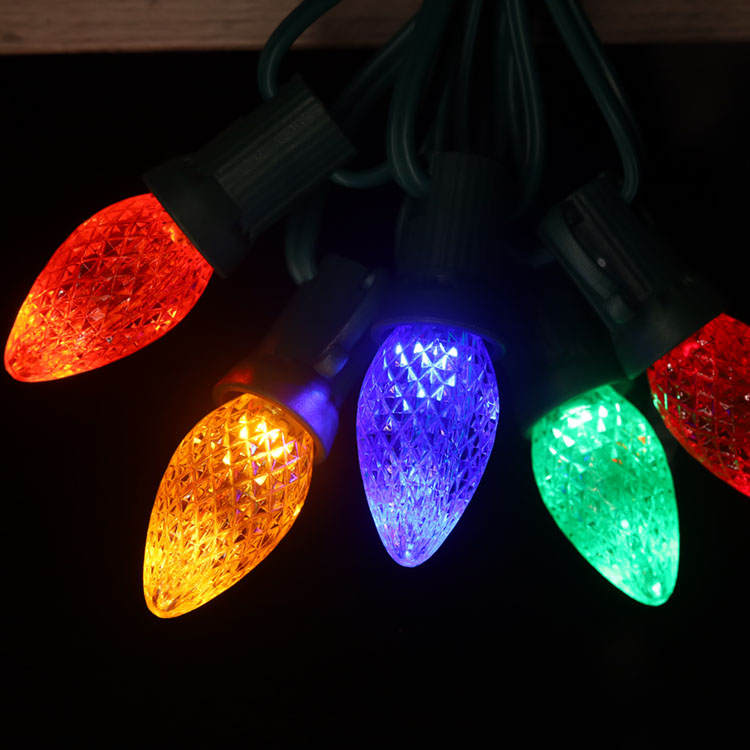
Stocking bulk C9 LED replacement bulbs is mandatory for any serious holiday lighting operation. The C9 profile serves as the undisputed industry standard for rooflines, gutters, and large commercial perimeters. Their large physical size provides excellent daytime visibility and massive nighttime impact. Selecting the right diode count dictates the success of these applications. Five-diode C9s deliver intense brightness for commercial properties competing with ambient city light. Three-diode variants offer a perfect balance of rich color and lower power draw for sprawling residential rooflines. Standardizing your C9 inventory simplifies truck loading and eliminates confusion on the job site.
For intricate detail work, wholesale C7 Christmas replacement bulbs provide unmatched versatility. The smaller C7 profile excels in residential applications, tight architectural wrapping, and ground-level pathway lighting. Their compact size allows for tighter bulb spacing on the stringer. You can achieve a dense, continuous line of light without overloading the property's electrical circuits. C7s are ideal for wrapping large outdoor trees where bulky C9s would look disproportionate and heavy. They offer a refined, elegant look that high-end residential clients prefer.
Expanding your services requires versatile form factors like G50 Christmas replacement bulbs. These spherical, globe-style lights offer massive crossover appeal. They look stunning in holiday canopy displays and transition seamlessly into year-round patio installations. Suspending heavier globe bulbs across wide spans requires specific mounting techniques. You must use high-tensile support cables to prevent the electrical wire from stretching and snapping under the weight of the larger G50 lenses. Proper tensioning ensures the display remains safe and visually striking through severe wind storms.
Commercial clients increasingly demand advanced lighting capabilities. Smart, programmable, and dimmable replacement bulbs are capturing a larger share of the market. RGBW (Red, Green, Blue, White) technology allows clients to change their display colors for different holidays without reinstalling new hardware. Deploying these advanced bulbs requires specialized controllers and robust data distribution networks. You must ensure your field technicians are trained in low-voltage data wiring to support these high-end programmable systems.
Consistent color temperature separates amateur displays from professional installations. LED binning is the highly technical manufacturing process of sorting diodes by their exact color output and voltage. Poorly binned LEDs result in a disastrous mix of yellow-white and blue-white bulbs on a single roofline. You must vet your suppliers for strict Kelvin tolerances. Demand documentation on their binning standards before placing a volume order. A reliable supplier guarantees that a warm white bulb purchased in August matches a replacement bulb purchased in December.
Managing vendor relationships can be incredibly frustrating. Poor communication during peak season and opaque inventory levels are the two biggest issues contractors face. You need a supplier who answers the phone in November. Establish clear communication channels early in the year. Demand real-time access to their inventory portals. A reliable vendor acts as a partner, providing transparent updates on shipping delays and stock shortages before they impact your scheduled jobs. Transparency allows you to pivot and adjust your installation schedules proactively.
Mid-season restocking capabilities make or break your December profitability. Partnering with suppliers who rely entirely on drop-shipping from overseas is a massive risk. You need vendors who hold deep inventory in domestic warehouses. Evaluate a supplier's historical ability to fulfill emergency orders during the late-November rush. If a major storm takes out a client's display, you need replacement materials on site within forty-eight hours. Domestic inventory depth guarantees you can service your clients when they need you most.
Understanding warranty terms and RMA realities protects your bottom line. Deconstruct standard commercial warranties carefully. A three-year guarantee looks great on paper, but the actual claims process matters more. A frictionless Return Merchandise Authorization (RMA) process is mandatory. Avoid suppliers who require you to ship back individual failed bulbs for testing. True commercial partners offer bulk replacement credits based on photographic evidence or batch failure rates. Streamlined RMAs keep your administrative overhead low.
Implementing strict pre-season testing protocols prevents job site disasters. Never send untested materials directly to a property. Establish a standardized process for batch-testing bulk orders the moment they arrive at your shop. Plug in every stringer and inspect the bulbs for color consistency and dead diodes. Identifying a bad batch in October gives you time to secure replacements. Discovering a bad batch on a frozen roof in December destroys your schedule and damages your reputation.
Efficient storage and takedown practices dictate your material costs for the following year. Train your crews on post-season bulb removal techniques. Pulling stringers aggressively from gutters shatters lenses and damages internal wiring. Pack bulbs in rigid, breathable containers to prevent crushing. Moisture mitigation during storage is absolutely critical. Ensure all materials are completely dry before sealing them in bins. Trapped moisture corrodes sockets and destroys diodes over the summer.
Conduct a thorough inventory audit during the packing process. Knowing exactly what survived the season informs your purchasing cycle and prevents over-ordering in the spring. Separate damaged goods immediately so they do not accidentally end up on a truck next season. A well-organized warehouse translates directly to faster load times and more efficient deployments when the next season begins.
Follow these warehouse management protocols to extend the lifespan of your lighting inventory:
Store all polycarbonate lenses in temperature-controlled environments to prevent extreme thermal expansion and contraction.
Label every storage bin with the exact Kelvin temperature and manufacturing batch number to ensure perfect color matching next season.
Inspect the vampire teeth inside your SPT-1 and SPT-2 sockets for rust before threading new bulbs into the line.
Discard any stringers that show signs of UV degradation or brittle insulation to prevent electrical shorts.
Take these immediate actions to prepare for the upcoming season:
Audit your existing warehouse stock to identify high-failure batches from previous seasons.
Request physical diode samples from three different suppliers to test color consistency and base threading.
Calculate your total linear footage requirements based on last year's completed jobs plus projected growth.
Submit your finalized purchase orders before early-buy manufacturing deadlines expire.
A: Commercial-grade, sealed LED bulbs typically last three to five seasons under normal winter conditions. Lifespan depends heavily on total hours of operation, UV exposure, and the severity of freezing weather. Proper storage and careful takedown practices significantly extend their usable life.
A: C9 bulbs are larger, use an E17 base, and provide high visibility for rooflines and large commercial perimeters. C7 bulbs are smaller, use an E12 base, and are ideal for intricate architectural wrapping, small residential profiles, and dense tree lighting.
A: Mixing brands is highly discouraged. Different manufacturers use varying LED binning standards, resulting in mismatched color temperatures and uneven brightness. Mixing brands can also introduce voltage irregularities that may shorten the lifespan of the diodes.
A: Yes, G50 bulbs with thick polycarbonate lenses easily withstand freezing temperatures and resist shattering. However, you must verify that the specific bulb base features a high IP rating and is fully sealed to prevent melting snow from causing internal corrosion.
A: Purchase your entire inventory from a single supplier that enforces strict LED binning processes. Always buy an extra ten to fifteen percent buffer from the exact same manufacturing batch to ensure perfect color matching for future mid-season repairs.
A: Optimal wattage ranges from 0.45W to 0.8W for standard commercial C9 LEDs. This low power draw allows contractors to safely run hundreds of feet of continuous lighting on a single circuit without tripping breakers or causing dangerous voltage drops.
A: Nickel plating prevents the bulb base from rusting and corroding when exposed to winter moisture. This prevents the bulb from fusing to the socket, saving significant labor time during takedown and preventing permanent damage to your stringer lines.


