
- All
- Product Name
- Product Keyword
- Product Model
- Product Summary
- Product Description
- Multi Field Search
- Product private attributes
Views: 0 Author: Site Editor Publish Time: 2026-10-12 Origin: Site


Upgrading a holiday lighting display often stalls at a visual crossroad: choosing the right bulb finish. Selecting the wrong lens clashes with architectural aesthetics, creates uneven brightness, or fails to deliver the intended impact. Buyers struggle to visualize how different bulb surfaces manipulate LED light output at scale. You want a cohesive display, but the variety of lens types complicates the process.
This guide breaks down the technical differences between ceramic, transparent, and faceted finishes. We provide a framework to select the exact Christmas Replacement Bulbs required for commercial-grade or high-end residential displays. You will learn how lens materials alter color temperature, affect daytime visibility, and interact with ambient light. By understanding these physical properties, you can engineer a lighting setup that meets strict visual standards.
Ceramic/Opaque Finishes: Deliver deep, saturated color and a nostalgic, painted-glass aesthetic, ideal for classic roofline outlining.
Transparent Finishes: Maximize lumen output and brilliance, making them the standard for high-visibility commercial displays and foliage illumination.
Faceted Textures: Offer a hybrid solution, using diamond-cut surfaces to refract light, masking the internal LED diode while maintaining high brightness.
Material Durability: Modern polycarbonate LED replacements eliminate the fragility and color-chipping risks associated with traditional painted glass bulbs.
A successful lighting display relies on specific visual criteria. You need uniform color temperature across all rooflines. You must match the brightness to the viewing distance. Architectural harmony requires bulbs that complement the building's exterior. The finish of your bulb directly dictates whether you achieve these goals. It is not just a cosmetic choice. The lens material physically alters how light travels from the diode to the viewer's eye.
Understanding light dispersion versus color saturation helps narrow your options. Transparent casings project light outward sharply. They allow the raw intensity of the LED to shine through without obstruction. Opaque casings diffuse light. They scatter the photons across the inner surface of the lens. This creates a glowing orb effect. The light appears softer, but the color saturation looks much deeper. You trade raw brightness for a richer hue.
Viewing angle and directionality play massive roles in display planning. Internal SMD (Surface-Mounted Device) LEDs emit directional light. Different casings manipulate this directional beam to achieve true 360-degree visibility. A clear lens lets the directional beam pass through relatively unaltered. A frosted or textured lens bends the light. This refraction ensures the bulb looks equally bright whether viewed from the street or the sidewalk.
Lens material impacts the perceived Kelvin rating of white bulbs. An opaque lens softens and warms a 3000K white LED. It filters out some of the harsher blue spectrum light. A transparent lens delivers a stark, crisp output. The exact same internal diode will look different depending on the shell. You must account for this color temperature shift when matching new bulbs to an existing display.
Daytime visual weight is another critical factor. Your display spends most of its time turned off. Opaque bulbs maintain their color profile during the day. A red opaque bulb looks like a solid red ornament hanging on the gutter. Transparent bulbs blend into the background. They become virtually invisible against dark roofing or foliage. You must decide if you want the bulbs to serve as daytime decorations or remain hidden until dusk.
Lens Material | Light Dispersion | Color Saturation | Daytime Visibility |
|---|---|---|---|
Ceramic / Opaque | Highly Diffused | Deep & Rich | High (Looks like an ornament) |
Transparent / Clear | Direct & Sharp | Bright & Piercing | Low (Blends into background) |
Faceted / Textured | Refracted & Scattered | Balanced | Medium (Catches sunlight) |
The visual characteristics of C9 opaque LED replacement bulbs mimic traditional incandescent ceramic bulbs. They feature a smooth, painted look. The internal LED interacts with the frosted polycarbonate shell to eliminate hot spots. You cannot see the internal diode. Instead, the entire surface of the bulb illuminates evenly. This creates a solid sphere of colored light.
These bulbs excel in specific environments. Traditional and vintage-themed displays rely heavily on this finish. They evoke a strong sense of nostalgia. Residential rooflines benefit greatly from opaque lenses. Homeowners often prefer a softer, warmer glow over piercing brightness. Installations requiring distinct, readable colors from a short to medium distance also favor opaque bulbs. The heavy color saturation makes reds look deeper and greens look richer.
You must consider the trade-offs and limitations. Opaque materials block a percentage of the light. This results in a lower perceived lumen output. They may not stand out in areas with high ambient street lighting. If you place opaque bulbs next to a bright streetlight, they can look washed out. You need a darker environment to maximize their visual impact. They are not designed to cast light onto surrounding objects.
Scuff resistance in storage gives opaque finishes a distinct advantage. Polycarbonate lenses are tough, but they can scratch. Opaque finishes tend to hide minor scratches and scuffs better than clear smooth bulbs. The frosted texture camouflages surface abrasions. This extends their pristine visual lifespan across multiple seasons. You spend less time worrying about perfect storage conditions and more time installing.
When installing opaque bulbs on a roofline, pay attention to the color sequence. Because the colors are so saturated, any mistake in the pattern stands out immediately. A standard red-green-white pattern looks incredibly sharp with opaque lenses because the colors do not bleed into one another. The light stays contained within the bulb's sphere.
Provide a nostalgic, retro aesthetic reminiscent of the 1950s.
Eliminate harsh glare, making them perfect for low-hanging rooflines.
Deliver deep, rich color saturation that remains visible during the day.
Hide internal LED components completely for a uniform glow.
Conceal minor surface scratches sustained during off-season storage.
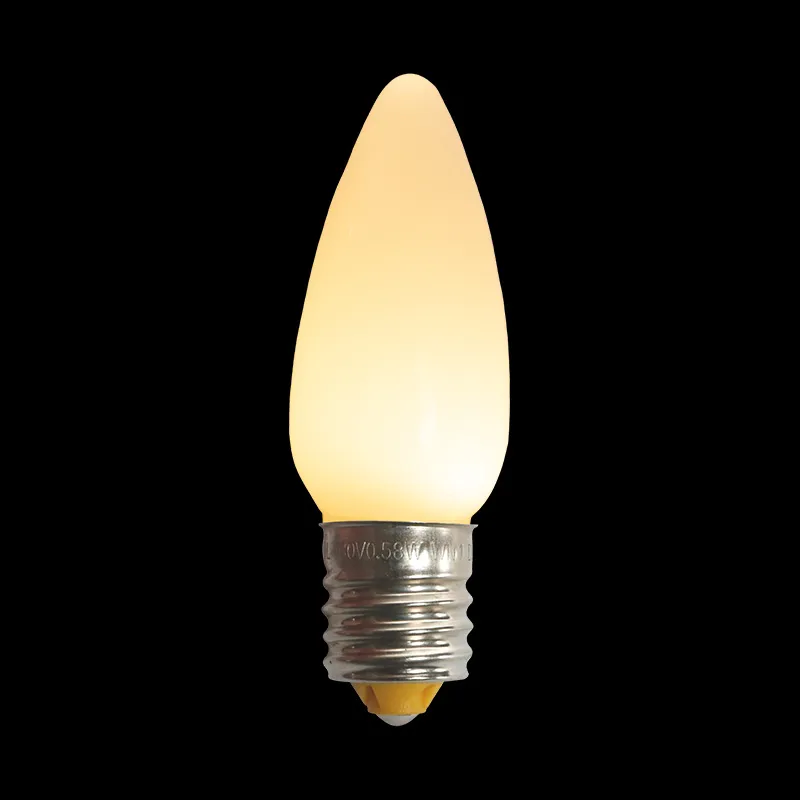
The visual characteristics of C9 transparent LED replacement bulbs focus on raw brilliance. The clear casing allows the internal filament or diode tower to be fully visible. This mimics traditional incandescent sparkle. The light does not diffuse. It travels directly through the smooth polycarbonate. This creates a sharp, intense pinpoint of light that cuts through darkness effortlessly.
Transparent finishes dominate specific use cases. Commercial properties and high-traffic areas require maximum visibility. Transparent bulbs draw the eye from long distances. Wrapping large evergreen trees demands high lumen output. The light needs to penetrate dense foliage. Transparent bulbs push light past the pine needles. Modern, crisp architectural outlining also relies on clear lenses. Warm white or pure white LEDs look exceptionally sharp through a transparent shell.
You must manage the potential for harsh glare. If viewed from too close, transparent bulbs can overwhelm the eye. The pinpoint light effect is intense. Some users find this less visually comforting than a diffused glow. You should avoid placing transparent bulbs at eye level along walkways. Keep them elevated on rooflines or deep within tree branches to mitigate the glare.
Light pollution and glare considerations require careful planning. You must manage intense lumen output to avoid neighborhood light trespass. Densely packed residential installations can quickly become a nuisance if they are too bright. Pointing transparent bulbs directly at neighboring windows will cause complaints. You must angle the sockets carefully. Use transparent bulbs strategically to highlight features without flooding the entire street with light.
When wrapping a 40-foot oak tree, transparent bulbs are the only logical choice. The clear lens allows the light to bounce off the bark and surrounding branches. This creates depth within the canopy. An opaque bulb would simply look like a glowing dot stuck to a branch, failing to illuminate the structure of the tree itself.
Installation Height | Recommended Lens Type | Glare Risk |
|---|---|---|
Ground Level (0-4 ft) | Opaque / Ceramic | High |
Porch / Entryway (5-9 ft) | Faceted | Medium |
First Story Roof (10-15 ft) | Transparent or Faceted | Low |
Second Story & Trees (15+ ft) | Transparent | None |
When you cannot decide between opaque diffusion and transparent brilliance, you look to the hybrid option. C9 faceted LED Christmas bulbs fit perfectly in the middle. They serve as the industry-standard compromise. They combine the best traits of both smooth finishes. You get the high light output of a clear bulb with the glare reduction of a frosted bulb.
The texture and light refraction benefits are significant. The diamond-cut texture catches and scatters light in multiple directions. This increases the perceived size of the light source. The bulb looks larger and brighter from a distance. However, it does not sacrifice actual brightness. The facets act like tiny prisms. They break up the intense pinpoint of light into a dazzling, sparkling effect.
Color consistency and blending improve drastically with faceted lenses. The textured surface helps blend the light. Slight variations in LED color binning become less noticeable. If one diode is slightly warmer than another, the facets mask the difference. This makes them highly forgiving for large installations. You can mix batches of bulbs with less fear of visual mismatch.
Comparing faceted against smooth finishes reveals distinct advantages. Faceted hides the internal diode better than transparent, but lacks the retro painted look of ceramic. It provides a highly durable surface that resists visible scratching. The texture hides dust and hard water spots effectively. This reduces maintenance time before installation.
Faceted bulbs excel in mixed-use displays. If you want to outline your gutters, wrap your porch columns, and light up a front yard maple tree using the exact same bulb style, faceted is the way to go. It adapts to different viewing distances and ambient light levels better than any other finish.
Feature | Ceramic / Opaque | Transparent / Smooth | Faceted / Textured |
|---|---|---|---|
Light Output | Soft, diffused glow | Intense, sharp pinpoint | Sparkling, refracted light |
Glare Level | Very Low | High | Medium |
Daytime Appearance | Solid, bold colors | Clear, blends in | Textured, jewel-like |
Best Application | Retro rooflines | Commercial displays | Large trees & mixed use |
Diode Visibility | Completely hidden | Fully visible | Partially obscured |
Evaluating power draw and LED diode quality is mandatory for large installations. Upgrading to LED from incandescent reduces wattage by up to 90%. A standard C9 incandescent pulls 7 watts. A standard C9 LED pulls roughly 0.8 watts. This allows you to run vastly longer stringers on a single circuit. Diode quality affects color consistency across large batches of bulbs. High-quality SMD LEDs maintain their Kelvin rating and color saturation over thousands of hours. Cheap diodes degrade quickly, leading to a patchwork appearance.
Dimmability and controller compatibility dictate your animation options. You must verify if replacement bulbs are compatible with animated lighting controllers or standard dimmers. Not all LED bulbs can dim smoothly. The internal driver determines dimming capability. Lens finish affects the visual smoothness of a fade effect. Opaque bulbs fade beautifully, creating a soft glowing transition. Transparent bulbs can sometimes show a slight flicker during a slow fade due to the stark visibility of the diode.
Weather resistance and IP ratings separate professional bulbs from retail junk. Traditional glass is fragile. The paint chips and fades under UV exposure. Modern SMD LED polycarbonate lenses are shatterproof. They resist UV degradation and feature waterproof seals. An IP65 rating ensures the internal components remain dry during heavy rain and snow. You can drop a polycarbonate bulb on concrete without breaking it. This durability drastically speeds up the installation and takedown process.
Socket compatibility and wiring require strict attention. You must clarify the difference between C9 and C7 stringers. C9 uses an E17 intermediate base. C7 uses an E12 candelabra base. They are not interchangeable. You must match the bulb base to your existing empty sockets. Mixing different bulb types on the same run introduces risks. You can experience voltage drops or visual inconsistencies. Stick to one bulb style and one base size per continuous run to ensure uniform performance.
When planning your wire runs, always calculate your total amperage. Even with low-wattage LEDs, pushing too many bulbs on a thin 18-gauge wire over a long distance causes voltage drop. The bulbs at the end of the run will look noticeably dimmer than the bulbs at the start. Use 16-gauge wire for commercial runs exceeding 200 feet.
Verify your existing stringer base size (E17 for C9, E12 for C7) before ordering.
Calculate total wattage to ensure you do not overload your electrical circuits.
Check dimmability specifications if connecting to an animated light controller.
Confirm IP65 or higher waterproof ratings for all outdoor installations.
Inspect empty sockets for corrosion before threading in new replacement bulbs.
Use dielectric grease on the bulb threads to prevent moisture ingress.
Analyzing the lifespan ratio justifies the investment in commercial-grade LED replacement bulbs. The upfront premium is higher than retail string sets. However, the long-term return on investment is undeniable. You benefit from drastically reduced energy bills. You experience zero replacement of broken glass. Professional LED bulbs boast 50,000+ hour lifespans. You buy them once and use them for a decade. The labor savings alone make them worthwhile. You stop wasting time hunting for dead bulbs in the freezing cold.
Avoiding cheap plastics prevents catastrophic display failures. Budget bulbs suffer from severe UV degradation. Clear bulbs turn a sickly yellow after one season in the sun. Opaque bulbs fade to washed-out pastels. Cheap seals allow moisture ingress. Water reaches the internal diode and causes immediate failure. You end up replacing the cheap bulbs every year. Investing in UV-treated polycarbonate and fully sealed bases eliminates these recurring headaches.
Maintenance and storage best practices protect your investment. You must properly store smooth versus faceted bulbs. Surface abrasions dull light output and ruin the finish over time. Do not throw bulbs loosely into a cardboard box. Store them threaded into the stringer. Coil the stringers carefully. If you must remove the bulbs, store them in compartmentalized containers. Keep them away from extreme heat during summer storage to protect the internal drivers.
The environment dictates your maintenance schedule. Coastal areas deal with salt spray. Salt corrodes electrical contacts quickly. You must wash the bulbs with fresh water at the end of the season. Urban areas deal with exhaust soot. Soot coats the lenses and reduces lumen output. A quick wipe with a microfiber cloth restores their brilliance. Proper care ensures your chosen finish looks exactly as intended year after year.
There is no universally superior bulb finish. The choice depends entirely on your specific application, viewing distance, and desired aesthetic. Opaque bulbs deliver nostalgia. Transparent bulbs deliver brilliance. Faceted bulbs deliver a balanced, sparkling compromise. Understanding how light interacts with these materials allows you to build a professional, cohesive holiday display.
Measure your total linear footage and count your existing empty sockets to determine exact quantities.
Verify your stringer base size by checking if you need an E17 (C9) or E12 (C7) threaded base.
Order a small sample pack of opaque, transparent, and faceted bulbs to test against your home's exterior.
Evaluate the sample bulbs at night from the street to confirm the brightness and color temperature meet your expectations.
Purchase your final selection in bulk to ensure all bulbs come from the same manufacturing color bin.
A: Technically, yes, if the bases match. However, it creates severe visual dissonance. The transparent bulbs will appear much brighter and sharper, while the ceramic bulbs will look softer and dimmer. This uneven light distribution ruins the cohesive look of a professional display.
A: Yes. Modern SMD LEDs match or exceed the lumen output of traditional incandescents. Transparent LEDs often appear even brighter due to the stark, unfiltered light projecting through the clear polycarbonate lens.
A: Yes. An opaque or frosted lens slightly warms up a white LED. It diffuses the light and filters out some cooler tones. A transparent lens allows the true, crisp Kelvin rating of the diode to shine through unaltered.
A: Commercial-grade opaque LED bulbs use UV-treated polycarbonate. The color is mixed into the plastic, preventing fading. Cheap retail bulbs often use painted glass or untreated plastic, which will fade or chip under prolonged sun exposure.
A: It depends entirely on the internal driver of the specific bulb. Many commercial-grade LEDs are dimmable, but you must check the manufacturer's specifications before connecting them to animation controllers or standard dimmers to prevent flickering.
A: The difference lies in the size and the base. C9 bulbs are larger (over 2 inches tall) and use an E17 intermediate base. C7 bulbs are smaller (about 1.5 inches tall) and use an E12 candelabra base. They are not interchangeable.


