
- All
- Product Name
- Product Keyword
- Product Model
- Product Summary
- Product Description
- Multi Field Search
- Product private attributes
Views: 0 Author: Site Editor Publish Time: 2026-10-17 Origin: Site


Installing, removing, and storing traditional single-color seasonal lights multiple times a year creates massive logistical friction. Climbing tall ladders in freezing weather introduces unnecessary physical hazards. Property owners constantly face the recurring headache of untangling wires, hunting down dead bulbs, and repeating the entire grueling process just a few months later. You need a permanent solution.
The core problem lies in finding a single, durable lighting infrastructure that transitions seamlessly from Halloween orange to Christmas red and green, and then to 4th of July red, white, and blue. Traditional disposable strings fail after one season of harsh weather exposure. They also look entirely out of place when left hanging during non-holiday months. You need fixtures that blend into the architecture by day and deliver powerful illumination by night.
Modern technology has solved this cycle. The industry has shifted heavily toward commercial-grade and premium consumer RGB Outdoor Lighting systems. Treating exterior illumination as a permanent architectural investment rather than a disposable seasonal purchase eliminates annual maintenance. You install the system once, control the themes from a smartphone, and enjoy reliable performance year-round.
Categorical Divide: The market is split between temporary smart strings and permanent track systems; your choice dictates both budget and installation complexity.
The RGBCW Advantage: True year-round utility requires systems with dedicated white diodes (RGBCW) to provide standard architectural lighting when holiday colors are not in use.
Durability Over Software: While app features sell systems, physical durability (IP65+ ratings, UV-resistant housing, commercial-grade wiring) determines the actual lifespan and ROI of the investment.
Ecosystem Lock-in & Expandability: Selecting a system commits you to its specific software ecosystem. Prioritize platforms that allow for seamless daisy-chaining and offer local control options or proven smart home integration (Matter, HomeKit, Google, Alexa) to mitigate software obsolescence.
Deploying a multi-holiday lighting system requires clear success criteria. A successful installation must eliminate the physical labor of seasonal decorating while elevating the property's nighttime aesthetics. You cannot settle for systems that require constant troubleshooting or physical modifications every few months. The infrastructure must operate autonomously once configured.
The absolute baseline requirement for any modern system is software-driven theme management. You must be able to change lighting themes entirely through an application rather than physically swapping out colored bulbs. Premium systems utilize preset holiday animations and allow for deep customization. You can program static color holds for elegant architectural washing, or deploy blinking, pulsing, and chasing effects for festive displays. The transition from a subtle warm white evening glow to a dynamic holiday light show should take exactly one tap on your smartphone. We often see homeowners struggle with manual timers. A proper smart system handles scheduling automatically based on sunset times and geographic location.
Permanent systems must respect the property's daytime appearance. A successful deployment remains visually unobtrusive or completely invisible during daylight hours. Exposed wires, drooping strings, and bulky plastic nodes detract from curb appeal. High-end solutions utilize custom-matched aluminum tracks or flush-mount channels that blend seamlessly into fascia boards and eaves. When the lights are off at noon, guests and neighbors should not even realize the property has a holiday lighting system installed. We match track colors to the exact drip edge or soffit paint code. This hides the hardware completely and maintains the architectural integrity of the building.
Weather resilience separates premium infrastructure from disposable retail products. You should expect flawless connectivity stability and maximum uptime regardless of environmental conditions. The hardware must withstand extreme climate variations, from blistering summer heat radiating off asphalt shingles to sub-zero winter freezes. Connectors must resist moisture ingress during heavy rainstorms. Control boxes must maintain solid network connections without requiring weekly reboots. We always mount controllers in weatherproof enclosures, even if they claim outdoor ratings, to guarantee long-term operational stability.
Understanding the distinct hardware categories helps you match the right technology to your specific property requirements. Each category serves a different primary function. Many successful deployments combine these systems to create a cohesive exterior lighting strategy.
Permanent track systems represent the pinnacle of exterior illumination. These setups house individual LED nodes inside custom-extruded aluminum tracks mounted directly under eaves and behind fascia boards. The metal tracks protect the wiring from UV degradation and physical damage while hiding the hardware from street view. Installers typically use J-channel or snap-in profiles depending on the roofline construction.
This category excels at permanent, invisible-by-day architectural downlighting. During non-holiday periods, they wash the exterior walls in elegant warm white light, functioning as high-end security and accent lighting. When holidays arrive, the same hidden diodes produce brilliant, customizable color shows. This approach requires precise measurement and often professional installation. It delivers the most polished, integrated aesthetic available.
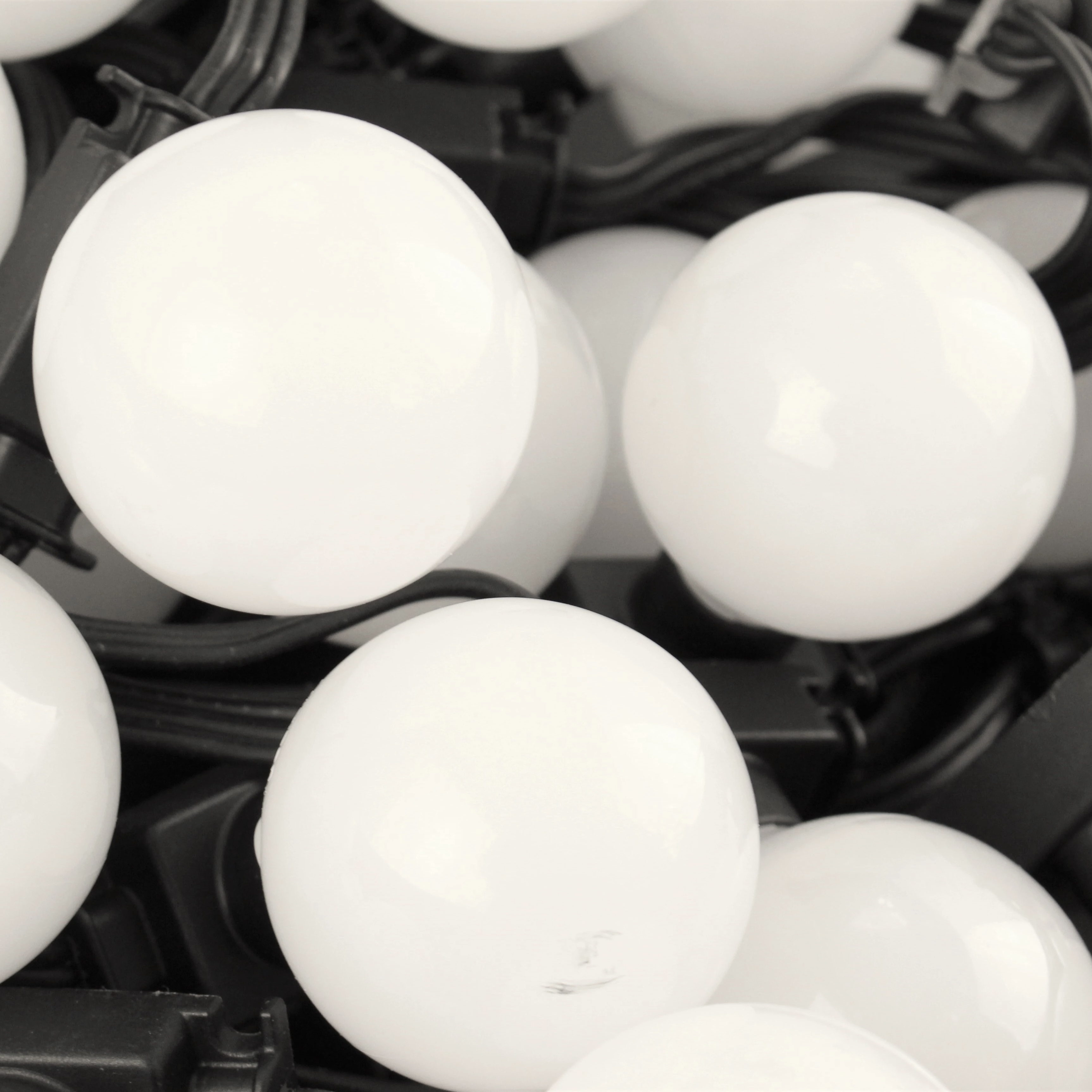
For wrapping large oak trees, draping across dense bushes, or executing semi-permanent roofline installations, programmable RGB holiday lights provide unmatched flexibility. These high-end smart string ecosystems allow you to map the exact position of every individual bulb using your smartphone camera. Once mapped, the software understands the 2D or 3D layout of the lights, allowing you to swipe complex animations across complex shapes.
Smart strings are highly versatile. You can coil them around porch columns or string them along balcony railings. They serve as the ideal solution when upfront hardware investment constraints prevent a full track-lighting deployment. They also work perfectly when you need to illuminate organic landscaping features that rigid tracks cannot accommodate.
Roofline displays look incomplete without ground-level illumination to anchor the property. Integrating RGB outdoor decorative string lights across patios and pergolas creates a cohesive lighting environment. You can pair these overhead patio strings with color-shifting floodlights aimed at large trees and integrated paver lights lining the driveway.
Ground-level seasonal color-shifting complements the primary roofline display. When the roof pulses in holiday colors, the landscape lighting can hold a steady matching hue to balance the visual weight. Furthermore, utilizing outdoor smart plugs allows you to integrate older, non-smart landscape fixtures into your broader holiday lighting schedule. This ensures the entire property turns on and off in perfect synchronization.
Lighting Category | Best Application | Installation Difficulty | Daytime Visibility |
|---|---|---|---|
Permanent Track Systems | Rooflines, eaves, architectural washing | High (Professional recommended) | Invisible (Color-matched tracks) |
Smart String & Icicle | Trees, bushes, columns, temporary rooflines | Low to Medium (DIY friendly) | Visible (Exposed wires/nodes) |
Landscape & Hardscape | Patios, pergolas, pathways, uplighting | Medium (Requires ground wiring) | Low (Blends with landscaping) |
Evaluating hardware requires looking past marketing claims and examining the actual physical and digital engineering. The longevity and performance of your lighting investment depend heavily on these technical specifications.
Ingress Protection (IP) ratings dictate how well a fixture survives outdoors. IP65 is the absolute bare minimum for any exterior lighting. It ensures the fixture can withstand low-pressure water jets from any direction, such as heavy rain or a garden hose. However, if you are installing lights at ground level where snow might pile up, or in areas prone to standing water, IP67 or IP68 ratings become mandatory to survive temporary submersion.
Beyond moisture, UV degradation destroys cheap plastics rapidly. Prolonged sun exposure causes standard plastic diode covers to turn yellow and brittle. This severely impacts color accuracy and light output over a five-to-ten-year horizon. Premium systems utilize UV-resistant polycarbonate lenses and heavy-duty, UV-shielded wire jackets. This prevents the insulation from cracking and exposing bare copper to the elements. We always check the wire gauge; 18 AWG wire holds up significantly better than thinner 22 AWG wire in harsh climates.
The software controlling your RGB color changing outdoor lights is just as important as the hardware. Connectivity protocols vary widely.
Wi-Fi: Offers straightforward setup but suffers from range limitations. If your router sits deep inside the house, the controller on the exterior garage wall might constantly drop offline.
Zigbee and Thread: Create robust mesh networks that extend range effectively across large properties by allowing each node to communicate with the next.
Proprietary RF: Offers bulletproof local reliability without relying on your home network, though it lacks remote cloud access.
Software longevity presents a real risk. Cloud-dependent apps can shut down if the manufacturer goes out of business, turning expensive smart lights into basic, unchangeable strings. Prioritize systems that offer local network control or integrate seamlessly with established smart home platforms. Advanced zoning and animation capabilities allow you to address individual bulbs or specific roofline sections. This enables complex multi-color holiday themes rather than just flashing the entire house a single color.
Standard RGB diodes mix red, green, and blue light to create colors. However, standard RGB struggles immensely to produce a clean, warm white. It usually results in a harsh, bluish-purple tint that looks terrible for everyday architectural lighting. This makes RGBCW technology mandatory for year-round use. RGBCW includes dedicated Cold White and Warm White diodes alongside the color diodes. This delivers pure, true-white illumination for non-holiday nights.
Form factor also impacts the final look. Flush-mount puck lights sit flat against the soffit, pushing light directly down the wall. This creates a beautiful wall-washing effect ideal for architectural highlighting. Conversely, traditional C9 bullet nodes point outward toward the street, delivering the classic, highly visible holiday aesthetic. Your choice depends entirely on whether you prioritize subtle wall-washing or vibrant, direct-view holiday displays.
When modifying runs or repairing damaged sections, standard electrical tape fails outdoors within months. You must use marine-grade heat shrink tubing with internal adhesive lining. When heated, the adhesive melts and seals the splice against moisture. We also recommend using dielectric grease on all threaded connections to prevent corrosion over time. Proper splicing ensures the data signal remains strong across the entire installation.
Evaluating the true value of an exterior lighting system requires looking beyond the initial hardware acquisition. A comprehensive analysis must account for installation labor, operational efficiency, and the realistic lifespan of the components.
The initial investment varies drastically based on the system architecture. DIY smart strings present a lower barrier to entry but often require significant personal time on ladders and manual cable management. Professionally installed permanent track systems demand a higher initial allocation but eliminate all physical labor. When assessing value, you must factor in hidden components. Power supplies, data controllers, custom track color matching, and specialized mounting hardware often add significant requirements to the base per-linear-foot calculation. We always tell clients to account for the cost of renting a boom lift if their roofline exceeds two stories.
The ability to link multiple sets together seamlessly is the holy grail of consumer lighting. However, physical limitations exist. You cannot daisy-chain endless strings of LEDs without consequence. Every system has a maximum run length before the data signal degrades or the power drops. Exceeding these limits requires secondary controllers or strategic power injection points. Understanding these linking limits upfront prevents frustrating mid-installation redesigns when you realize a single controller cannot push data across your entire roofline.
Running LED systems nightly introduces operational energy requirements. Fortunately, modern LED technology operates with extreme efficiency. A typical permanent installation draws significantly less power than traditional incandescent floodlights. Baseline calculations for wattage per foot reveal that running an entire architectural display at 70% brightness consumes minimal electricity. Utilizing the software to schedule precise on and off times further optimizes energy consumption. This ensures the system only draws power when actually visible.
Manufacturers frequently market LED lifespans of 50,000 hours. While the diodes themselves rarely burn out, you must plan for realistic failure points. Power supplies fail after years of thermal cycling. Controllers can burn out from power surges. Water ingress at poorly sealed connection points causes localized shorts. Therefore, system modularity is vital. You must evaluate whether a single dead bulb or damaged wire segment can be spliced and replaced, or if an entire section of the display must be discarded due to a single failure. In our field experience, modular systems save thousands in replacement costs over a ten-year period.
Even the highest quality hardware can fail if implemented poorly. Anticipating common installation and operational risks ensures your lighting system performs flawlessly from day one.
Homeowner Associations frequently enforce strict rules regarding permanent light fixtures and off-season colors. Installing a highly visible system without approval risks steep fines. Additionally, overly bright installations can cause light trespass, bleeding unwanted illumination into your neighbors' bedroom windows.
You can mitigate these risks easily:
Utilize permanent track systems that match your fascia color, rendering them invisible during the day.
Rely on the dedicated warm-white RGBCW settings as your default, strictly adhering to HOA guidelines for non-holiday periods.
Utilize software dimming schedules and precise downward-facing puck lights to control the beam spread and eliminate neighborhood light pollution.
Voltage drop is a hard technical limitation. As power travels down extended linear footage of wire, resistance causes the voltage to decrease. This results in lights at the end of a long run appearing noticeably dimmer or displaying inaccurate colors. They often shift toward yellow or red.
Mitigating voltage drop requires proper power injection planning. You must run parallel power lines to inject fresh voltage at specific intervals along the installation. Furthermore, utilizing appropriately gauged wire is critical. A 12V system typically drops off after 30 to 40 feet without injection. A 24V system pushes power much further, often reaching 80 to 100 feet before experiencing voltage drop. This makes 24V architecture vastly superior for large residential or commercial rooflines.
Multi-story roofline installations present severe physical safety risks. Working on extension ladders or steep roof pitches while managing long strands of wire and power tools leads to frequent accidents. Navigating a 12/12 pitch roof requires entirely different safety gear than a standard 6/12 pitch.
Mitigate these hazards by honestly assessing your capabilities. If the installation requires working above a single story, navigating complex roof peaks, or hardwiring electrical components into the main breaker, hiring certified, insured installers is the safest and most efficient route. Professional crews possess the correct scaffolding, harness equipment, and electrical expertise to execute the deployment safely.
The physical location of your control box dictates system reliability. Never mount controllers in direct sunlight, as thermal overload will cause random reboots and hardware failure. Place them in shaded areas, preferably inside a garage or under a deep patio cover. Ensure the location has a strong Wi-Fi signal. If the signal is weak, install an outdoor-rated mesh access point nearby rather than relying on cheap Wi-Fi extenders.
To move forward with your exterior lighting upgrade, take the following immediate actions:
Measure the exact linear footage of your primary rooflines, eaves, and desired landscape perimeters to establish an accurate material baseline.
Locate all exterior electrical outlets and note their distance from your planned starting points to determine power supply placement.
Verify your local HOA guidelines regarding permanent exterior modifications and acceptable non-holiday lighting temperatures.
Request a hardware sample from manufacturers to test the difference between standard RGB and RGBCW diodes against your exterior paint.
A: Yes, provided you select commercial-grade hardware. True permanent use requires high UV resistance to prevent plastic degradation, IP65 or higher ratings to block moisture, and aluminum track housings to protect the wiring from physical weather damage and hide the system during the day.
A: RGB uses red, green, and blue diodes to mix colors, which often creates a harsh, unnatural white. RGBCW adds dedicated Cold White and Warm White diodes. This allows the fixture to produce pure, elegant architectural white light for everyday use when holiday colors are not active.
A: Yes, but strict physical limits apply. You can daisy-chain sets until you hit the controller's data limit or experience voltage drop. Exceeding these limits requires adding power injection lines or utilizing secondary controllers grouped together via the smartphone app for synchronized displays.
A: No, LED technology is highly efficient. Most systems draw less than one watt per node. Running a typical residential roofline at standard brightness consumes minimal electricity, often drawing less power than running a few traditional incandescent landscape floodlights.
A: Control is managed primarily through dedicated smartphone applications connected via Wi-Fi, Zigbee, or Bluetooth. These apps allow you to create custom animations, set daily schedules, and integrate the lighting with smart home platforms like Alexa or Google Assistant for voice activation.
A: Generally, yes, if installed correctly. To ensure compliance, use track housings color-matched to your trim so they remain invisible during the day. During non-holiday periods, run the lights exclusively on a warm-white setting to mimic standard, approved architectural accent lighting.
A: Premium permanent systems are modular. If a single node fails, you can typically cut that specific bulb out, splice a replacement node into the wiring, and seal it with waterproof heat shrink. You do not have to discard the entire string.


